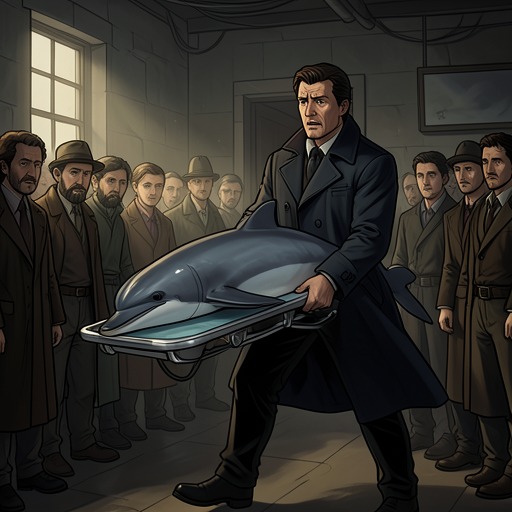
Jasper Kesper
Made for LoveJasper Kesper’s defining predicament is the collision between a life built on convincing performances and a bodily change he cannot simply perform away. A seasoned con artist accustomed to controlling how others read him, he responds to the dolphin encounter by trying to minimize its effects; later, he disguises himself as Larry Winkler and takes a job at the Oceanarium. When he seeks help through Gogol’s intake process, even entering the facility compromises his anonymity for the rest of his life.
Identity and Disguise
Jasper has spent more than a decade making a living through cons that depend on performed romantic conviction. His success rests on making each encounter persuasive enough that the other person believes in a deep, destined connection. The work reveals both his skill at reading and influencing people and the distance between the intimacy he stages and the trust on which it depends.
A prepared getaway bag is part of his ordinary precautions. It reflects an expectation that a con may go wrong and that someone drawn into it may become dangerous once the deception is exposed. The bag contains a stolen driver’s license and Social Security card belonging to Larry Winkler. Jasper does not resemble Larry closely, but he counts on their shared baldness and whiteness to make the impersonation plausible, explaining the difference as a change in physical fitness. His assumed identity is thus not an elaborate reinvention so much as a practical story designed to survive casual scrutiny.
The Dolphin Encounter and Its Effects
After a brutal encounter with a dolphin, Jasper tells himself not to panic or exaggerate what happened. He tries to understand his diminished sexual confidence as a temporary, frightened response that needs patience and reassurance. This self-talk shows him attempting to regain control by turning an unfamiliar change into a manageable problem, though it does not resolve what has happened.
The later account makes clear that the effect is not limited to that single dolphin: Jasper experiences an unusually strong sexual response to dolphins generally. This is a marked break from the responses on which his livelihood has depended. He can no longer trust his body at work in the way he once did, and the change reaches beyond an isolated encounter into his ability to carry out his established con-artist persona.
Work at the Oceanarium
After Calla’s Taser incident, Jasper travels north along the coast for several states. He then uses Larry Winkler’s documents to obtain a custodial position at the Oceanarium, which houses five dolphins. One of them is Bella, who strikes him as the most inclined toward play. The job gives Jasper a new assumed identity and places him in regular proximity to dolphins, the very animals now linked to his involuntary response.
That juxtaposition makes the position more than an escape route. Jasper’s disguise lets him enter a workplace where his changed response is difficult to separate from daily life; beneath his uniform, he wears tight dance-club briefs and adds a plastic liner to conceal visible signs of arousal. The measures are uncomfortable, and their practical purpose exposes the strain behind his composed appearance. He is not simply hiding a past con: he is managing a present condition that threatens his ability to pass unnoticed.
Anonymity and the Search for Help
Jasper’s precautions do not prevent him from eventually entering Gogol’s intake process. The decision represents a sharp contrast with the habits that have kept him mobile: a prepared escape identity can protect him from the consequences of a failed con, but it cannot preserve his anonymity once he submits to an institutional process. He recognizes the cost as lifelong, even though the available account does not establish what treatment follows.
During the consultation, the specialist tells Jasper that the case is of particular interest and that the diagnostic team has filled in details he left vague when speaking with the operator. The exchange indicates that the intake has gathered information beyond what Jasper chose to volunteer. For a character whose craft depends on controlling what others believe about him, that scrutiny is consequential: seeking help requires him to enter a system that can assemble a fuller account than the one he deliberately presented. The episode leaves his response to that exposure unresolved, but makes the cost of pursuing assistance unmistakable.